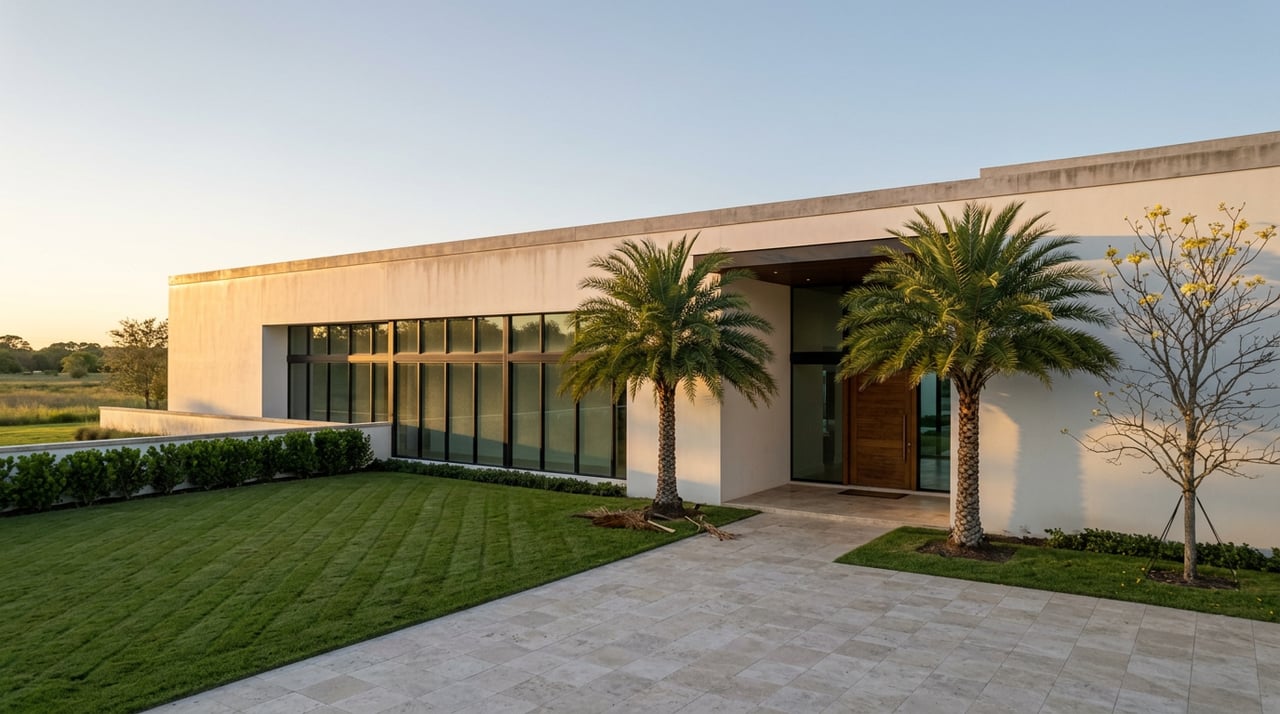
The Wellington Horse Farm Tax Break Doesn't Come With the Deed
September 24, 2026
September 24, 2026
Buyers looking at horse farms in Wellington tend to treat two numbers as fixed facts about the property: the tax bill and the zoning map. Both feel like they belong to the dirt, the way acreage or stall count does. Neither one does. The tax break that makes a ten-acre farm affordable to hold resets the moment title changes hands, and the zoning line that supposedly protects the Equestrian Preserve has already moved once, with a fight over moving it again still active this year.
If you're comparing farms in Saddle Trail, Grand Prix Village, Palm Beach Point, Rustic Ranches, Aero Club, Homeland, or Winding Trails, both of these mechanics matter more than the listing photos of the barn.
Most Wellington horse farms carry a Florida Greenbelt agricultural classification under Florida Statute 193.461. Instead of taxing the land at market value, the county appraiser taxes it at agricultural use value, which for pasture and horse operations runs far below what the same acreage would fetch if it were assessed as residential or development land. The Palm Beach County Property Appraiser's own agricultural guidance spells out how granular that qualification is. For equestrian use specifically, the standard is two full sized animals per acre, with grazing animals required to have access to the acreage granted the classification.
That precision is the point. The classification is not a status attached to the parcel. It is a factual determination the county makes every year, based on how the land is actually being used, and it does not travel with the deed.
The University of Florida's IFAS Extension is clear that the county property appraiser makes the official determination of whether land is in bona fide agricultural use, and that determination has to be renewed under new ownership. A buyer who closes on a farm mid-year inherits the seller's classification for that tax year only in the sense that the bill has already been set. To keep the break going forward, the new owner has to file Form DR-482 with the county appraiser, and the land has to be in qualifying agricultural use as of January 1 of the year being applied for. Miss that window and the exemption lapses until the next cycle.
Here is where the timing actually bites. A buyer who closes in June has already missed the January 1 use date for that tax year. If the seller's classification carries through to the following March 1 filing deadline without a fresh application in the new owner's name, the property can be reassessed at full market value instead of agricultural use value. For a working horse farm, that is not a rounding error. It is the difference between a tax bill built around pasture and one built around what the land would sell for as residential lots.
| Status | How the land is taxed | Who has to act |
|---|---|---|
| Greenbelt classification in place | Assessed at agricultural use value | County appraiser confirms the use is still bona fide |
| Sale closes, no new filing | Reverts to standard market-value assessment | New owner must file Form DR-482 by March 1 |
| Use shifts away from agriculture | Classification denied or removed | Owner can appeal to the Value Adjustment Board |
Buyers who assume the tax bill they saw in the listing carries forward automatically are the ones who get the surprise. The fix is straightforward but easy to miss in the excitement of closing: confirm with the seller whether horses will still be on the property and in bona fide use on January 1 of the year you take title, and calendar the March 1 filing deadline yourself rather than assuming it happens by default.
The second assumption buyers make is that the Equestrian Preserve Area, roughly 9,000 acres in the western and southern portions of Wellington, is a settled boundary. It is regulated by the Equestrian Overlay Zoning District, which Wellington's Council adopted to protect the character of a community built around show jumping, dressage, polo, and family farms. In 2016, Wellington voters approved a charter amendment by a two-thirds majority restricting hotels, motels, condos, and apartments inside the Preserve, a vote widely read at the time as a permanent line in the sand.
It was not permanent. In February 2024, the Village Council voted to approve a project from Wellington Lifestyle Partners, a joint venture between Mark Bellissimo's Wellington Equestrian Partners and Nexus Luxury Collection, whose investors include Tiger Woods. The approval removed 96 acres from the Preserve for the first time in its history, clearing the way for two developments: Wellington North, with 49 single-family homes, 47 townhomes, a clubhouse, and a golf facility replacing the Equestrian Village showgrounds, and Wellington South, with 107 luxury villas and five 4-acre farms on 290 acres, according to reporting in The Real Deal. The council vote was not unanimous. Vice Mayor Michael Napoleone was the lone no vote.
The debate did not end there. A Town-Crier opinion piece published in April 2026 argued that even the Equestrian Overlay Zoning District and the 2016 charter, despite overwhelming community support at the ballot box, provide only limited and not permanent protection, because those safeguards can still be amended or weakened by future council votes. That is not a fringe read of the situation. It is the same conclusion the 2024 vote already demonstrated in practice.
None of this means the Preserve is disappearing or that farms inside it are a bad bet. It means a buyer evaluating a specific parcel, especially one near the showgrounds corridor or adjacent to land that has already changed hands for development, should ask a narrower question than "is this inside the Preserve." The better question is whether this particular subarea has been part of a pending rezoning conversation, and what protections apply to it today versus what a future council vote could change. Several subareas within the Equestrian Overlay Zoning District cap density as low as one home per five acres, which is exactly the kind of detail worth confirming in writing before you assume a farm's low-density character is locked in for good.
A horse farm purchase in Wellington carries a few due-diligence steps that a standard residential closing does not:
None of these steps are exotic. They are the kind of paperwork a transaction-focused agent chases down before it becomes a problem at the closing table, rather than after.
Does the Greenbelt exemption transfer if I keep horses on the property the same way the seller did? Not automatically. Even if the use stays identical, the classification is tied to the owner of record and has to be reapplied for under your name, with the January 1 use date and March 1 filing deadline both in play.
Could the Equestrian Preserve boundary change again after I buy? It has already changed once, in 2024, and the debate over further changes was still active as of the April 2026 Town-Crier piece. Buying inside the Preserve does not make future council votes irrelevant.
Is this different from a typical South Florida closing? The core process is similar. What's different is the number of parallel systems that all have to line up on the same property: county tax classification, Village zoning overlay, floodplain rules, and often a private HOA layered on top.
If you're comparing horse farms in Wellington this season and want someone who will chase down the permit history, the subarea confirmation, and the tax filing calendar before you're staring at it at the closing table, reach out to Amy Awerbuch. Her background in staging and hands-on transaction management means the paperwork gets checked early, not discovered late.
September 24, 2026
September 17, 2026
September 10, 2026
September 3, 2026
August 27, 2026
August 20, 2026
August 13, 2026
August 6, 2026
August 6, 2026
Amy Awerbuch has truly experienced the world of Real Estate from many unique perspectives, from marketing home furnishings for a major Midwest Design Center to selling and listing high-end residential properties and owning and managing an Arizona luxury vacation rental in Cave Creek.